

 en
en
 English
 繁体中文
繁体中文 Japanese
 Korean
 Russian
 German
Nachricht
Vertiefung der optoelektronischen Ressourcen, Erschließung technologischer Durchbrüche

Vertiefung der optoelektronischen Ressourcen, Erschließung technologischer Durchbrüche
 Zuhause / Ressourcen / Nachricht / Hemisphere Dome for Sale for Optical Systems and Precision Imaging Applications
 In precision optical engineering, the concept behind Hemisphere dome for sale is not simply a protective enclosure, but a wavefront-preserving optical interface designed to maintain controlled light propagation through curved geometry. A hemispherical dome introduces a continuously curved refractive surface that directly affects wavefront uniformity, refraction stability, and imaging distortion behavior.
ECOPTIK, with 15 years of optical manufacturing expertise, specializes in high-precision optical components including domes, spherical lenses, prisms, filters, and windows. Utilizing optical-grade materials such as K9, fused silica, sapphire, MgF2, ZnSe, and ZnS sourced from Schott, Corning, and CDGM, ECOPTIK produces hemispherical optical domes engineered for predictable optical transmission behavior under complex imaging and sensing conditions.
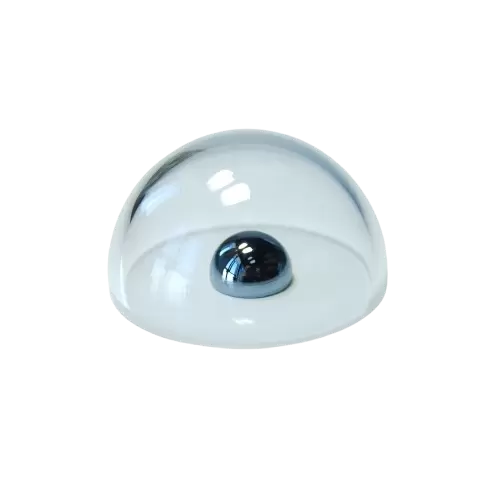
The optical function of a hemispherical dome is defined by its ability to preserve or intentionally modify wavefront propagation across a curved refractive boundary. Unlike flat optical windows, hemispherical geometry introduces continuously varying incidence angles across the surface, which must be carefully controlled to avoid distortion accumulation.
The first mechanism is continuous refraction angle redistribution, where incident light rays experience gradually changing refraction vectors across the curved surface, reducing abrupt phase discontinuities and stabilizing wavefront transition into internal optical systems.
The second mechanism is geometric aberration smoothing, where symmetrical curvature distributes optical path differences more evenly across the aperture, reducing localized distortion peaks that typically appear in flat optical interfaces under wide-angle illumination.
The third mechanism is wavefront stabilization under angular variation, ensuring transmitted wavefronts maintain predictable curvature behavior even when incident angles vary significantly across the dome surface.
Material selection is a decisive factor in defining the performance of any Best hemisphere dome for optical systems, as refractive index stability, dispersion behavior, and transmission uniformity directly affect imaging accuracy.
Fused silica provides extremely low thermal expansion and stable refractive index behavior across UV to IR wavelengths, making it suitable for laser and precision imaging systems requiring long-term wavefront stability.
Sapphire offers high mechanical strength and thermal resistance, maintaining optical integrity in high-energy environments such as aerospace sensing and high-power laser protection systems.
ZnSe and ZnS are commonly used in infrared optical systems where controlled dispersion characteristics are required for thermal imaging and IR transmission stability.
Surface quality in hemispherical domes is a primary determinant of optical system performance, especially in high-resolution imaging and laser sensing systems.
Surface scattering control at optical-grade levels (10/5 to 20/10) ensures that micro-defects do not introduce unwanted diffusion or stray light, which would otherwise degrade contrast and reduce measurement accuracy in sensitive optical environments with strict signal-to-noise requirements.
Sub-wavelength surface accuracy ensures that wavefront distortion remains within diffraction-limited thresholds, which is essential for high-precision imaging systems where phase stability directly affects resolution and measurement repeatability.
Angular alignment precision between geometric center and optical axis is equally important, as even small deviations can introduce beam displacement errors in long-path optical systems such as telescopic imaging or laser tracking platforms.
ECOPTIK applies Zygo interferometry and ZEISS CMM measurement systems to ensure that each hemispherical dome maintains strict curvature and surface conformity requirements.
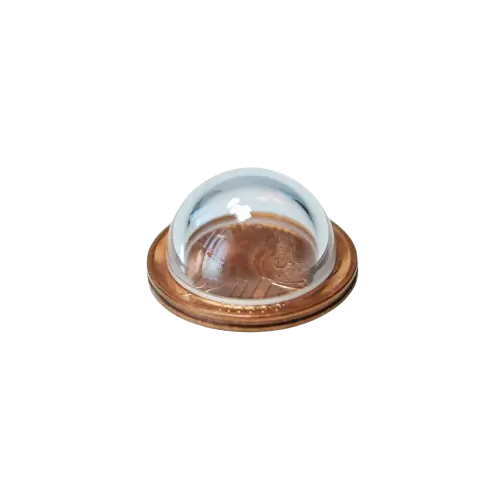
In industrial and scientific systems, Hemisphere dome for sale in optical applications refers to precision hemispherical windows used where both optical transmission and environmental protection are required.
Laser collimation and beam transmission systems rely on hemispherical domes to maintain stable wavefront propagation while minimizing external contamination effects, ensuring that beam geometry remains predictable even under variable incident angles and long operating durations.
Wide-field optical sensor protection systems use hemispherical geometry to preserve large field-of-view imaging without introducing significant angular distortion, which is critical for surveillance, tracking, and measurement applications requiring spatial consistency.
A key engineering challenge in hemispherical optics is controlling distortion introduced by curved refractive surfaces. Unlike flat windows, hemispherical domes introduce continuously varying optical path lengths that must be compensated through geometric and material precision.
Die Verzerrungsreduzierung wird durch eine hochpräzise Krümmungssteuerung erreicht, die einen gleichmäßigen Radius über die gesamte Oberfläche gewährleistet, um lokale Fokusdrift oder Wellenfrontverzerrung zu verhindern.
Reflexionsverluste werden durch Antireflexionsbeschichtungen (AR) auf einer oder beiden Oberflächen minimiert, wodurch Fresnel-Reflexionen reduziert und die Übertragungseffizienz über die vorgesehenen Wellenlängenbereiche verbessert werden.
Die Gleichmäßigkeit der Materialbrechung gewährleistet eine minimale interne Indexschwankung und verhindert Phasenverzerrungen, die andernfalls die Bildauflösung und Systemstabilität beeinträchtigen würden.
Flache optische Fenster sorgen für eine gleichmäßige Brechung bei senkrechtem Einfall, werden jedoch bei schräger Beleuchtung sehr winkelempfindlich, was zu einer Verzerrung des Sichtfelds und einer Verschlechterung der Bildqualität führt.
Halbkugelförmige Kuppeln verteilen die Einfallswinkel gleichmäßiger über die Oberfläche und ermöglichen eine stabilere optische Weitwinkelleistung, wenn sie ordnungsgemäß mit hochpräziser Krümmung und Materialgleichmäßigkeit hergestellt werden.
Dieser Vorteil gilt jedoch nur, wenn die Oberflächengenauigkeit und die Brechungskonsistenz streng kontrolliert werden, da kleine Abweichungen zu einer Wellenfrontinstabilität auf Systemebene führen können.
Die Leistung halbkugelförmiger optischer Kuppeln hängt stark von der Fertigungsgenauigkeit sowohl auf geometrischer als auch auf Materialebene ab. ECOPTIK setzt hochpräzise Form-, Polier- und Messprozesse ein, um Krümmungsgenauigkeit und Oberflächenstabilität sicherzustellen.
Durch das spannungsarme optische Schleifen werden Schäden unter der Oberfläche vermieden, die die Wellenfrontstabilität bei Lasereinwirkung oder langfristiger mechanischer Belastung beeinträchtigen könnten. Die interferometrische Inspektion stellt sicher, dass jede Kuppel genau der geplanten sphärischen Geometrie entspricht und nur minimale Abweichungen über die gesamte Öffnung aufweist.
Die Materialrückverfolgbarkeit von Schott, Corning, CDGM und anderen optischen Glaslieferanten gewährleistet ein konsistentes Brechungsindexverhalten und langfristige optische Stabilität über alle Produktionschargen hinweg.
Die thermische Stabilität wird durch Materialien mit geringer Ausdehnung wie Quarzglas aufrechterhalten, wodurch die Krümmungsverformung bei Temperaturschwankungen verringert wird. Die mechanische Stabilität wird durch hochharte Materialien wie Saphir verstärkt, die einer Verformung bei physikalischer Belastung und längerem Betrieb standhalten.
Die Haltbarkeit der Beschichtung stellt sicher, dass die Antireflexionsleistung über lange Betriebszyklen stabil bleibt und verhindert eine allmähliche Verschlechterung der Transmission, die andernfalls die Systemgenauigkeit und Bildzuverlässigkeit beeinträchtigen würde.
Die Auswahl der besten Halbkugelkuppel für optische Systeme erfordert ein ausgewogenes Verhältnis von Material, Krümmungsgenauigkeit, Oberflächenqualität und Beschichtungsleistung. Jeder Parameter wirkt sich direkt auf die Wellenfrontintegrität und Abbildungsgenauigkeit in hochwertigen optischen Systemen aus.
Fused silica is preferred for laser and precision imaging systems due to thermal stability and transmission consistency. ZnSe and ZnS are selected for infrared applications requiring wavelength-specific dispersion control. Sapphire is used in high-stress environments requiring maximum mechanical and thermal resistance.
ECOPTIK integrates these material capabilities with precision curvature control to ensure predictable optical performance in demanding engineering environments.
The engineering value of hemispherical optical domes lies in their ability to maintain controlled wavefront propagation under complex optical conditions. Properly designed hemispherical structures reduce distortion, stabilize refraction, and improve imaging consistency across wide-angle systems.
ECOPTIK, with 15 years of optical manufacturing expertise, produces high-precision hemispherical domes designed for wavefront stability, low scattering loss, and high geometric accuracy. In advanced optical systems, performance is ultimately defined by how consistently light behavior can be controlled under real-world conditions, and hemispherical domes play a critical role in achieving that stability.
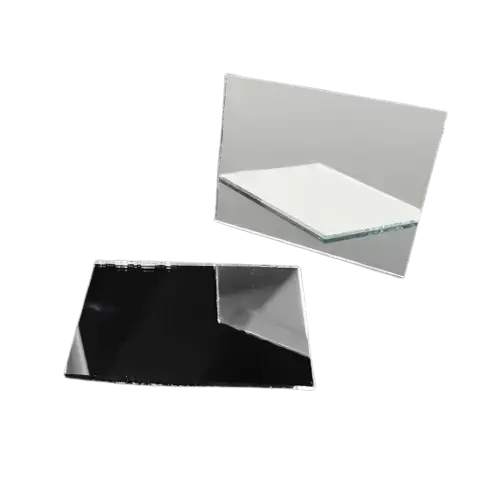
Bei optischen Präzisionssystemen wird die Spiegelauswahl oft durch Faktoren bestimmt, die im Normalbetrieb unsichtbar sind, sich aber direkt auf die Systemgenauigkeit auswirken. Ein Spiegel mag für das Auge perfekt reflektierend erscheinen, seine innere Struktur kann jedoch zu optischen Fehlern führen, wenn er in der Laserausrichtung, in bildgebenden Geräten oder in wissenschaftlichen Instrumenten verwendet wird.
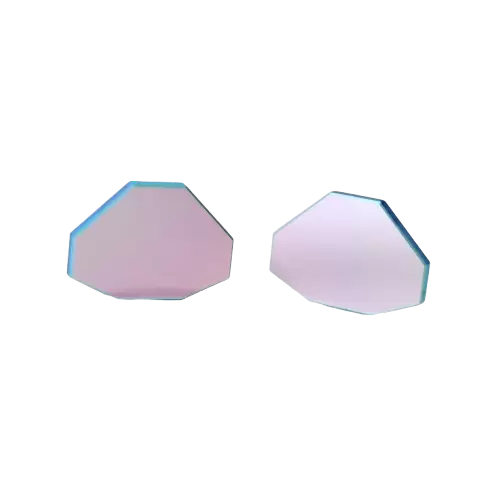
Von modernen Laserbearbeitungssystemen wird erwartet, dass sie einen höheren Durchsatz bei gleichbleibender Positionierungsgenauigkeit erreichen. Allerdings stoßen viele herkömmliche Laserscanning-Lösungen beim Betrieb mit hohen Geschwindigkeiten an ihre Grenzen.
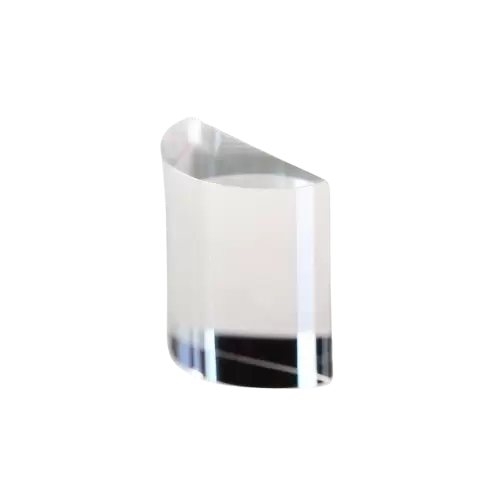
Optische Systeme benötigen nicht immer eine Linse, die das Licht in zwei Achsen bündelt. Wenn das Ziel darin besteht, eine Laserlinie zu erzeugen, einen linearen Detektor zu beleuchten, das Strahlseitenverhältnis zu ändern oder einen kollimierten Strahl nur in eine Richtung zu fokussieren, kann eine sphärische Linse einen unerwünschten optischen Effekt hervorrufen.