Zuhause / Brauch / Optische Komponenten / Infrarotoptik / Calciumfluorid (CaF2) Linse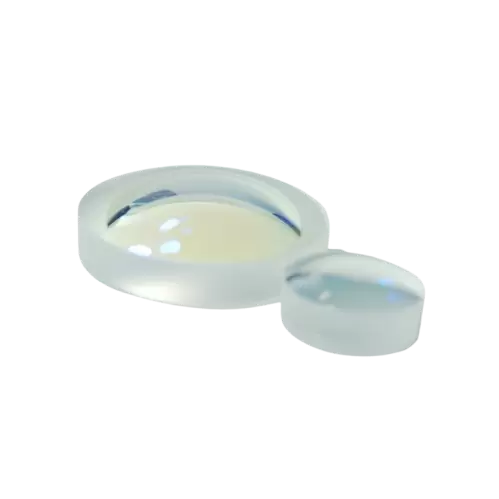
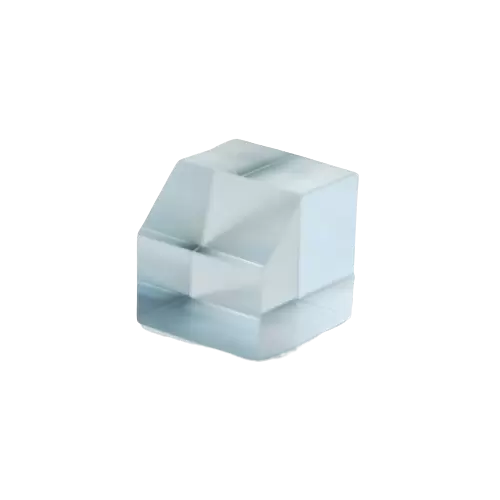
Calciumfluorid-Linsen (CaF₂) bestehen aus einem Calciumfluorid-Substrat. Calciumfluorid zeichnet sich durch ein breites Transmissionsspektrum (180 nm–8,0 μm), eine hohe Zerstörschwelle, geringe Fluoreszenz, hohe Homogenität und weiche physikalische Eigenschaften aus und dient als Basis für diverse optische Komponenten.

Its transmission band covers ultraviolet, visible, and mid-infrared (approximately 0.13-10 μm). It is almost a standard choice, especially in the deep ultraviolet below 180 nm and the mid-infrared band of 3-5 μm.
With a refractive index of approximately 1.35-1.51 and an Abbe number as high as 95, it effectively reduces surface reflection loss and significantly reduces chromatic aberration, making it an ideal material for high-quality imaging systems.
It can withstand extremely high laser energies, making it ideal for use with high-power laser sources such as excimer lasers.
It exhibits superior moisture resistance compared to other fluorides, is twice as hard as barium fluoride, and possesses excellent optical homogeneity and no birefringence.
Material | Calciumfluorid (CaF2) |
|---|---|
| Toleranz der Brennweite | ± 3 % |
Maßtoleranz | ± 1 % |
Dickentoleranz | ± 0,03 mm |
Oberflächengenauigkeit | △/v=0,3nm |
Oberflächenqualität | 10/5 |
Zentrierung | < 1 Bogenminute |
Freie Öffnung | > 90% |
Fase | < 0,1 |
 en
en